
Canada Day and at breakfast I started singing ‘O Canada’ and everyone joined in! Kris is the only American and the person who organized this trip, and he knew all the words and joined in too.
The trip to Coal Banks is about 35km-ish and we were up and on the water by just after 8am. To give you a sense of this routine – we’re a crew of 8 with Val acting as a Road Crew support with his big van. So we have to get up, pack our tents and gear together and assemble it for packing in Val’s van. At the same time, we’re getting our own breakfasts done (and, yes, the all important coffee off the Coleman camp stove that you remember from when you were a kid). Then, we carry our day-gear and paddles to the riverbank where the canoes are cabled to shore for safety.
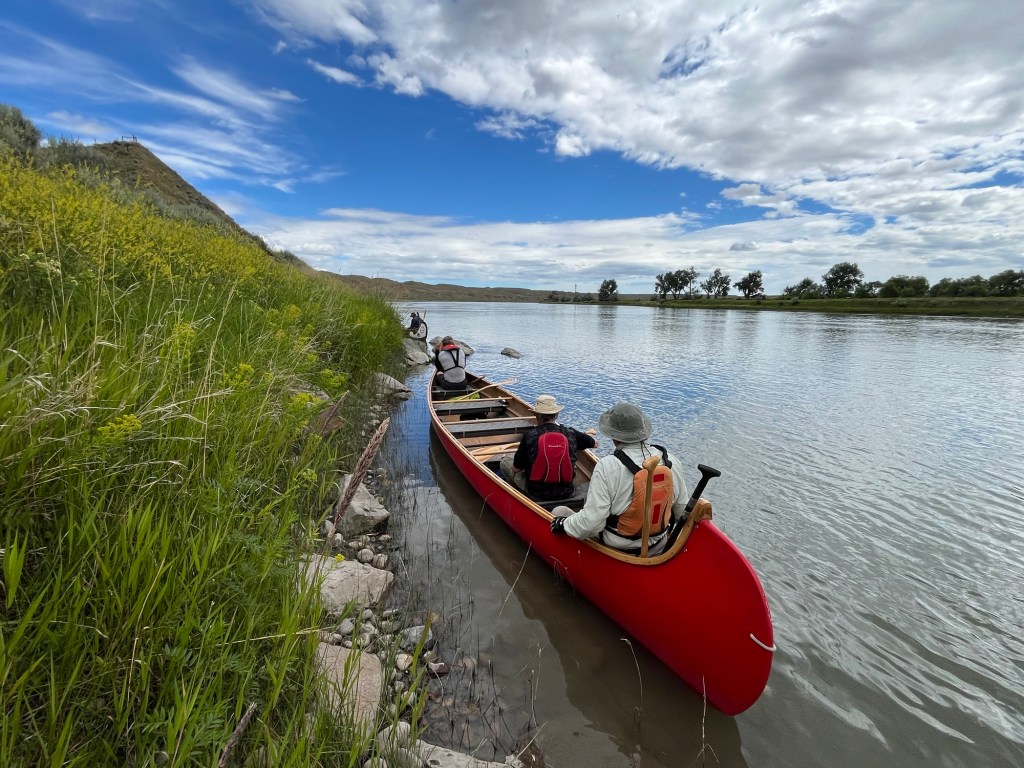
At this stage, whomever is steering (captaining) the boat for the day assigns seating to make sure the canoes will be balanced. The next step is to pick up these big 26’ voyageur canoes and lug them to the river – which is generally only a few feet as they are heavy. On this trip, we have 4 in each canoe, but they are made with seating for 6. After today’s paddle we will be in the wilderness and the centre 2 seating areas will be packed with everything from tents and sleeping bags to water, stoves and food.
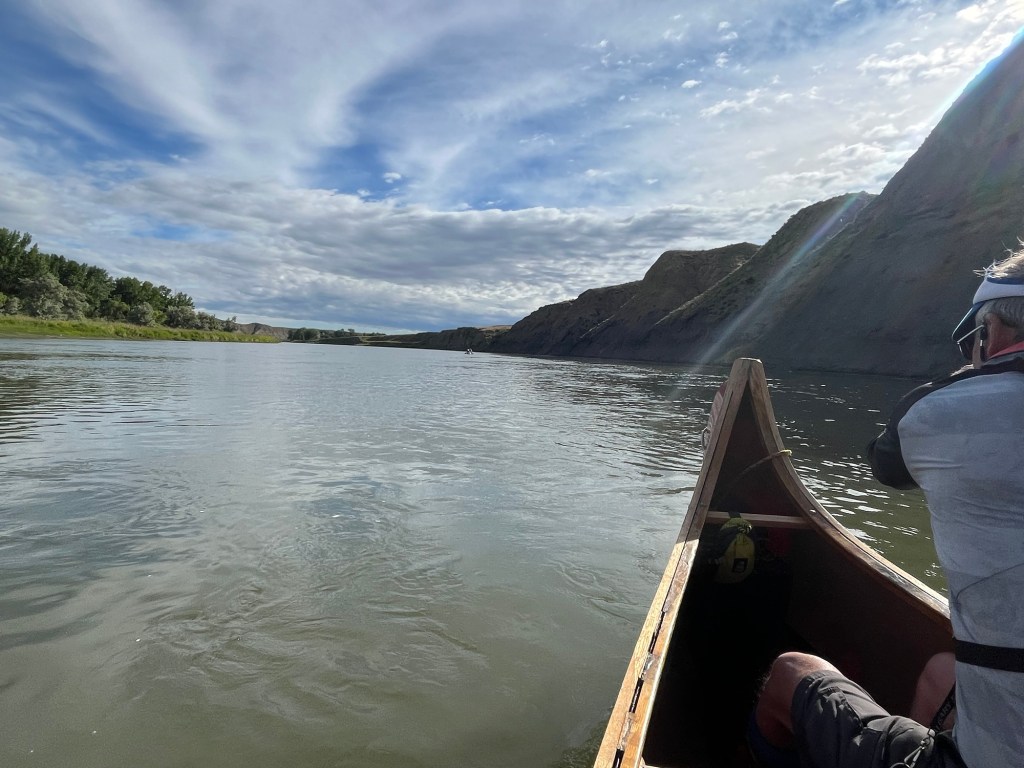
Once everyone is in place, we nose the bow into the current and we’re off down the river to the day’s adventure and stunning landscapes of the area.
The river in this section is flowing well and it feels good to have a strong current. There are no ‘rapids’ per se on this year’s journey, but there are sections hosting big rocks and some rougher water to negotiate. The water level is also dropping, so we’re constantly watching for shallows that can hang up the canoe. Merle has done this work for decades and thankfully takes the lead canoe role to help in that navigation.
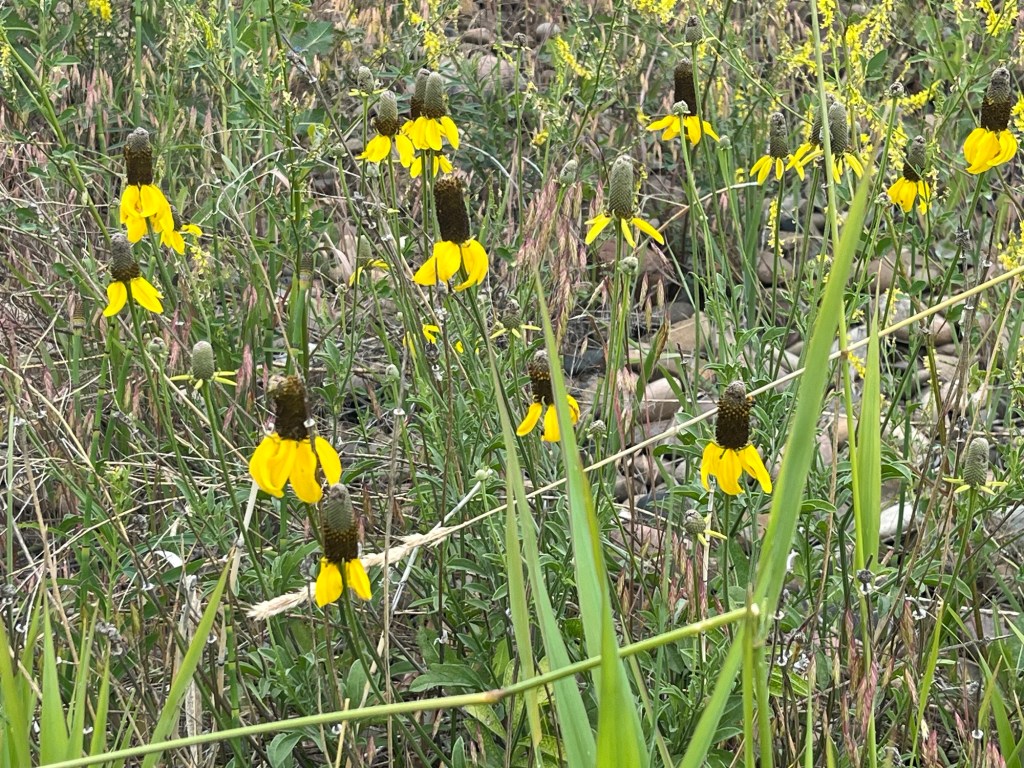
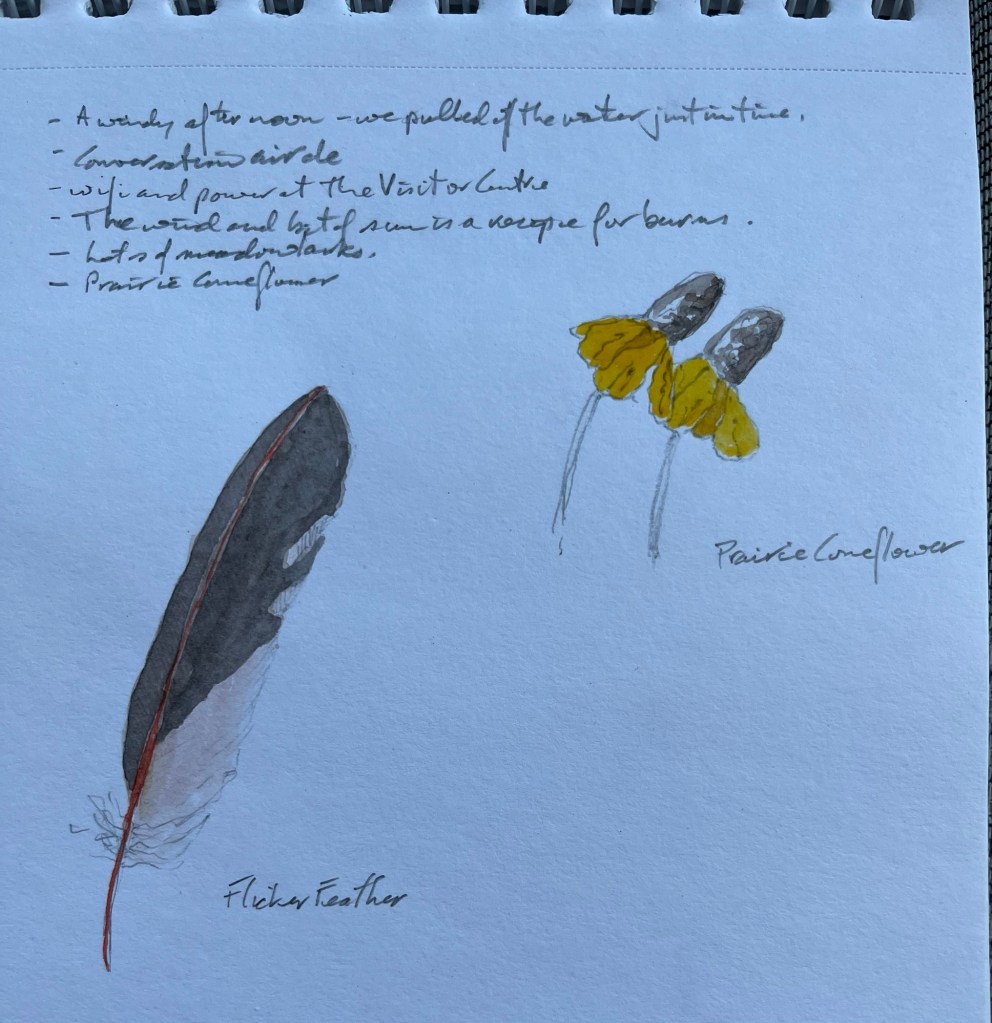
Nature Note – Prairie Coneflowers are a common plant that brightens the banks of the Missouri River in Montana.
For a crew our age and for the first big paddle of the year, this 4-hour stretch is just about perfect. A couple of the crew carry small GPS devices and our floating speed is 8-9 km/hr. Our faster sections of paddling took us to about 15km/hr.
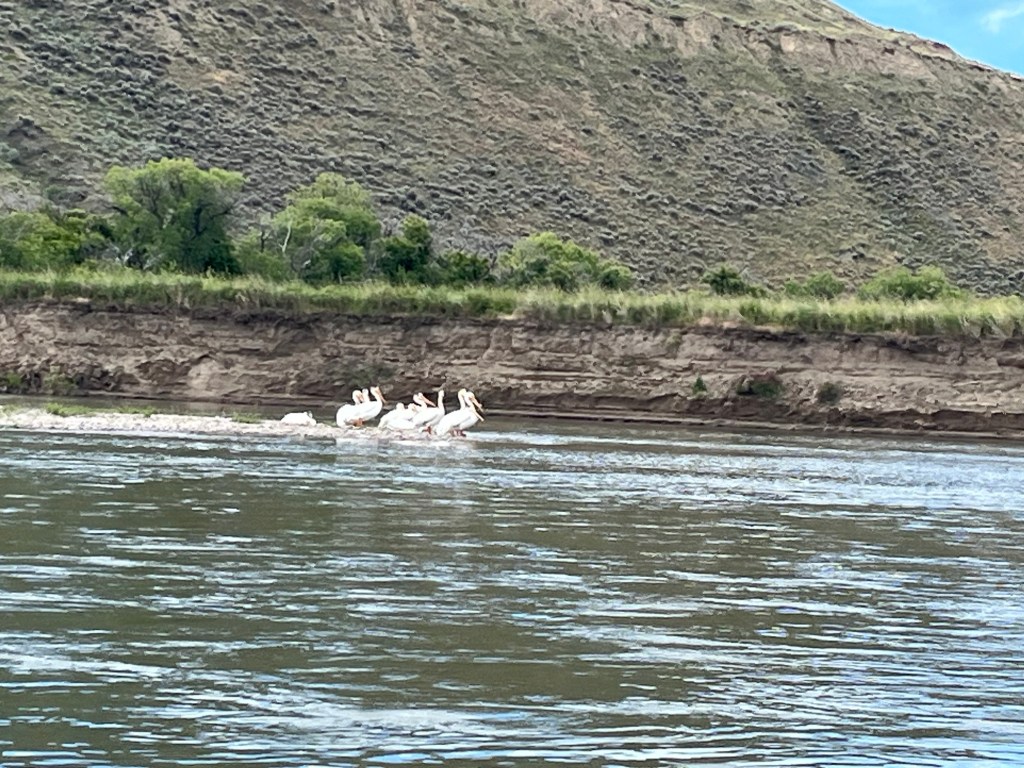
There are soooooo many birds on this trip and I think everyone has commented on that fact. Mourning doves and Meadowlarks in particular dominates the soundscape on this stretch of the Missouri River. Ever since I was a kid working in my Grandparents’ orchard in Oliver, BC, the sound of Meadow Larks has been a comforting song to hear!
By this time in the journey, I’m beginning to notice a few of my paddling habits or patterns. Our ‘switches’ from side to side very minute aren’t quite as smooth as they will be by the end of the trip. I’m bumping my paddle against the gunnels a little too much at the start. I’m doing the ‘counting’ to keep our switches on track, and I find that I get easily distracted by the beautiful landscapes and call the ‘switch’ a little too late for everyone’s liking. All this said, for a bunch of old toads like us, we’re not doing too badly at all!
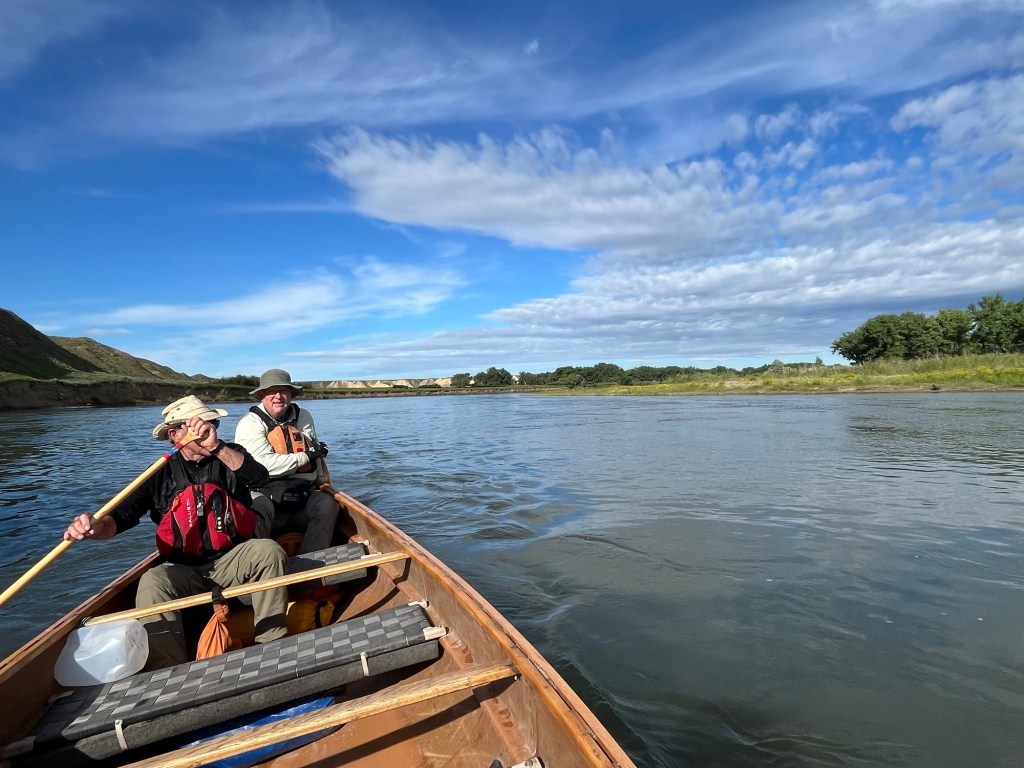
The final bit of the afternoon paddle got quite windy and I’ll tell you something personal about the wind and me. I find that, when I’m paddling into the wind (especially when it gets to be a hard wind)….I get mad! Odd eh! I’m not sure where this comes from – I’m sure some Sports Psychologist would have something to say about it. I find I lower my profile in the boat to cut the wind resistance and my focus on keeping my paddle strokes even and strong kicks in. Paddling into a harder wind like this is all about ‘business’ for me.
Lewis and Clark: June 2, 1805
‘ … the wind blew violently last night and was attended by a slight shower of rain; the morning was fair and we set out at an early hour.The wind was hard and against us yet we proceeded with infinitely more ease than the two preceding days.
The river bluffs still continue to get lower and the plains leveller and more extensive….’
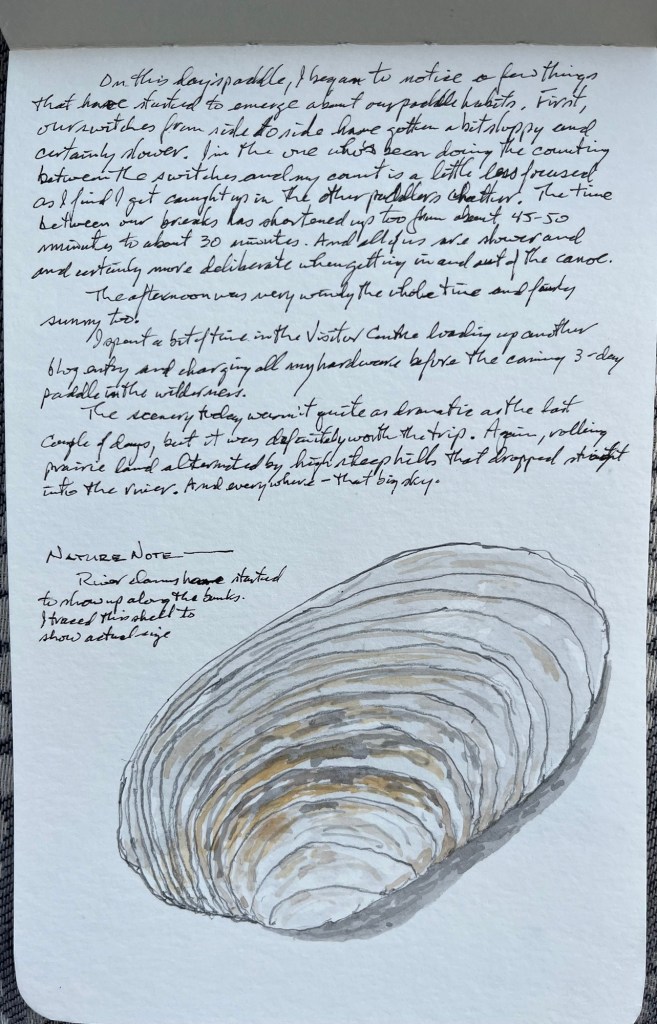
Nature Note – I’ve begun to see so many River Clam shells along the riverbank. They shine white in the hot Montana sun and catch the eye as we paddle past.
When we arrived in Coal Banks, someone had taken dozens of these old shells and placed them on top of all the posts marking the outline of the parking lot and campground. I am surprised to see so many of them as I tend to think of them as somewhat rare (or uncommon, at least).
Paddle Journal/Nature Journal.


 The Missouri Breaks
Leave a reply to geneva ensign-langin Cancel reply